Search This Blog

Friday, November 25, 2011

November 17: Rio Intag Coffee


November 17, 2009
Location: Carlos' Farm, Intag Cloud Forest
Weather: Sunny with clouds, mild again!

This may be the best place since the Galapagos. I'm in love with the food, the land, the experience of being in Intag. It's amazing how this country gets into your blood, like a drug. I feel on top of the world here, stronger and more capable than I've ever felt in America. Part of it must be making my own decisions and choosing my own adventure, if you will. Whatever I do is essentially me, uninhibited by friends or family or keeping up with appearances at home. If I want to stay up until 5 AM, it's on me to wake up and go to class or hike 5 miles the next day.

A bunch of us stayed up and talked by candlelight in the cabin until late, late at night yesterday. We brushed our teeth in the community sink, sat around on a few of the beds and gave each other back massages to work out the knots of the day's hike. It was a night that I think I will cherish for a long, long time in my life. You know those moments in life where you feel at peace with the world and those around you, like you can trust and care about those you're with to such a degree that you bare your soul without inhibitions and walls to protect you? That was last night. Paul, Emily, Jenny, Shannon, Lizzy, Nate, a few others and I talked about why we wanted to go on the trip, what we found here, and what we'll take back with us. We talked about the realities and blessings in life, the challenges and successes we experienced. Maybe it was the ambiance of the night. The cabin was dark except for the glow of a few candles. It seemed as if we were the only ones in the universe except for the night noises outside. Lulls in conversation weren't uncomfortable, they were reassuring and peaceful. Moments like these can't last forever but that's what makes them so special.

Today we toured the Rio Intag Coffee Co-op, where shade grown coffee is dried in the sun, sorted, roasted, bagged, and sent around the world. It provides income for families in town that doesn't rely on outside companies. It's sustainable, too! Students for Fair Trade at B-W gets coffee from the Co-op and sells it at school. It's an impressive process--and the coffee is phenomenal!

We then visited a sugar cane plantation and saw sugar cane squeezed to release its juices. We drank from a clay mug and marveled at how sweet it was. A river nearby looked inviting so we jumped in. Guess what? It was freezing. As per usual! :) It had a surprisingly strong current underneath the waterfall and Mark had a moment of panic as he was caught under. After that, we decided to dry off and hike back with Melampy.

He brought us to an outdoor distillery where they were making aguardiente, a sugar cane alcohol with an insane alcohol proof in this form. Cristal or Zhumir is a flavored form of it that we realllyyy like (especially the green apple and watermelon flavored kind!). We were offered shots of it straight from the distillery. Melampy looked disapproving as we sang a jungle version of LMFAO's "Shots": "If you ain't takin' shots, get the heck out the jungle!" The alcohol tasted horrendous but we ended up with a pretty fun series of pictures!

November 16: "Thank you for your shit." -Carlos Zorilla

Inside the candle-lit cabin
Jenny, Shannon, and I at the freezing waterfall at Carlos'
Lounging in the sun at Carlos' farm


November 16, 2009
Location: Carlos Zorilla's farm, the Intag Cloud Forest
Weather: Warm, sunny, beautiful

Carlos' farm is like something out of a documentary. Well, it is, actually. They made a documentary about him and his efforts to save this beautiful land. I'll explain in a bit.

After our bus ride, we loaded up our bags onto mules and horses and began the couple mile hike to Carlos' farm. Yes, it was so far off the beaten trail, we had to use pack horses. Isn't that awesome? A few of us (including Nance's friend Suki) got lost because we were walking ahead of the group but that was part of the adventure. We eventually broke into the clearing to find several houses spaced out in a clearing and an open-sided shelter where refreshments were waiting for us.

I can tell already that this is going to be a wonderful, wonderful time to eat good food. All of the food is vegetarian, which I can't say I'm too pleased about but what the heck, it's worth a shot. It has all been glorious so far!

A little bit of background on Carlos...

Copper and precious metal mining in Ecuador has been an enormous concern in the last few decades. Foreign companies come in and create huge pit mines to do hard rock mining. This process decimates the land. 250 tons of solid wast material is produced per ounce of gold, it creates acid drainage, it uses a LOT of water, and damage could last for 1000 years! There is a lot of mining in the Azuay province, near Cuenca, which creates environmental and social impacts as a result A lot of violence and dirty dealings are started by reckless mining companies. Canada especially has very lax regulations for mining and everyone and their brother can start a company.

Correa, the president of Ecuador, platformed on anti-mining campaigns but is changing his tune. He thinks Ecuador will be helped by mining but there is no evidence, according to Carlos, and it's all wishful thinking. Correa sees the money brought in by the mining and thinks it will create social help, "development," and "prosperity." Carlos says that development and prosperity is more than just money, it's about sustainability and healthy growth.

Research says that countries like Bolivia and Nigeria, who depend on mining are in worse shape. The more rich in metals and mining, the poorer the country. There is a link between mineral export and an economic dependency on it, which creates poverty in a boom-bust cycle. When the resources are gone, there is no agriculture or tourism to keep the monetary cycle going and the country is impoverished. There is a four times greater chance for a country to have a civil war if the country depends on mining. On top of that, only the elite see benefits of it. In Ecuador, only 5% of the money stays in the country. While the new constitution says that Ecuador must see a 50% rate of monetary retention in the benefits, companies are becoming creative. The World Bank and the IMF have laws and mining legislation to complicate it.

Carlos has begun a coffee co-op and a woman's co-op to create a new way to provide work and income, especially for those who wouldn't traditionally have the opportunity. In this way, he has successfully kept out the mining companies from the Intag area--so far.

He was visited by 19 hired paramilitary officers from a mining company who accused him of false crimes. Finding nothing in his house and property, they planted a gun and drugs on his property to complicate things. He then had to go into hiding for over a month to stay safe. "The Curse of Copper" documentary highlights his personal struggle and how other communities like Junin have fought the foreign companies to keep their land.

What Carlos has started in his own community is a movement that tries to be as sustainable as possible, using little to no electricity, little running water, and sustainable farming practices, as well as eco-tourism and awareness.

His farm is amazing. There are shade grown coffee trees (which help the Rio Intag coffee co-op, which we will see later), vegetables, fruits, and outhouses that provide fertilizer in an ingenious way...

The outhouse next to our cabin stood unobtrusively by our cabin in Carlos Zorilla's back field behind a flush of rose blooms, as if it was attempting to hide itself and be as inoffensive as possible under my scrutinizing gaze. I do not object to freezing showers, a shortage of water, throwing my toilet paper in a receptacle, or going for hours (or days) without electricity. But an outhouse? My experiences with those had been less than pleasant. My father's Amish friends had one when I was little in which I always had to plug my nose to block out the stench, and only used when I was about to pee myself and had no other option. Therefore, I did not use it until Carlos spoke with us later.

“Please put a cup-full of humus in the hole when you're finished using it to prevent the smell,” Carlos instructed us. “You know, I fertilize with that.” Fantastic, I thought. Not only did I need to use an outhouse, but I just ate a meal comprised entirely of vegetables fertilized with previous waste of Seminar in Ecuador students. I was starting to bristle at the idea of that.

“After three years, when the outhouse is filled, I move the building a few feet over, dig up the decomposed waste from the old pit, and leave the first pit to decompose again. Don't worry. I only put that fertilizer on the trees—not in the garden. It's completely safe, but you never want to risk it. So,” Carlos said in a completely dry tone, looking around at all of us, “thank you for your shit.”

That is the moment when I realized I could deal with using an outhouse: its owner had just thanked me for my bodily fluids. That example of recycling is telling of his attitude toward farming. His unhurried attitude purposefully reflects nature's slow pace. His goal is to mimic the forest in sustainable agriculture in the hopes of leaving the land as natural as possible, even while he uses it to his advantage. Carlos Zorilla's model for sustainable agriculture in the Intag Cloud Forest should be emulated elsewhere because it is beneficial for our environment because it eliminates chemical drainage, biodiversity loss, and the decimation of land, and our own future to make the most out of the land by protecting it and being good stewards of it.

He was turned a primitive series of cabins into a beautiful, simplistic life to share with us. We're split into three small cabins, but I'm in the biggest one. There is a loft area, a small kitchen area, and two large rooms with bunk beds. It's lit only by candles and night and has an outhouse and a freezing cold shower house. I love it.

We took a hike all over his beautiful land today--one of the most difficult I've made, but I'm getting into shape in this mountain air! There are so many unusual plant species and bird types and so much green newness it is hard to take in all at once. But I'm really loving it here. We hiked to a waterfall where we all dipped our heads into the icy water. It's not hot here by any means, especially compared to the Amazon, but we worked up quite a sweat getting there. On the way back, Jenny, Shannon, and I stopped at the large waterfall closer to the cabin. We were told we wouldn't need our bikinis on this part of the trip so we didn't bring them. FALSE. We stripped down to our sports bras and underwear and let the icy water pound down on our heads as we splashed and squealed like little children.

Cold water is a recurring motif on this trip and if I were home, I'd be appalled by it. Shower, bathe, and swim in water cold enough to numb my skin? No thanks. But here, it is refreshing, yes, even numbing, but it makes you feel alive. The little needles of ice are piercing your skin and making it glow red but you know that this is the essence of being human. You aren't pampered by hot water, you are facing nature and not shying away from it or trying to tame it. This is really living.

November 15: Red Hot Chili Peppers and Andy Warhol

Inside Warholic Bar
Enjoying margaritas at the Red Hot Chili Pepper!


Shannon, Jenny, and I took a break from the rest of the group to explore Quito--in sanity and peace. The group is wonderful and I really like them but traveling in a herd can be tiresome. Everyone knows you're American when there is 27 of you tromping about the city.

Seafood was the original goal of the evening but we found the Red Hot Chili Peppers bar and restaurant and had to try it. My (extremely touristy) travel guide said it had delicious fajitas and the best margaritas in the city. We bought a whole pitcher and it was as delicious as advertised. The irony of eating at a Mexican restaurant with an American band's name in Ecuador was obvious but it was packed with a whole range of people and we were really enjoying the strawberry margs.

Four glasses of strawberry margaritas, a fajita salad, and hours of laughter later (entailing a comparison between the table's extra virgin olive oil and myself), we met up with Nate, Megan, Antonia, and Ashley to go to No Bar, a discoteca with a lively atmosphere and a bar (despite the name) on which we all danced. Yes, I danced on a bar.

The second bar we went to was the Warholic, where all the walls were covered in pop art and wonderful Andy Warhol prints. It was absolutely genius! I didn't drink a bit, just wandered around taking pictures of the decor. It was one of the coolest bars I've ever been in.

We left the Maple early to take a four-hour bus trip to Intag. I slept for most of it. We're getting close and I'm really excited!

November 14: The Return to Civilization

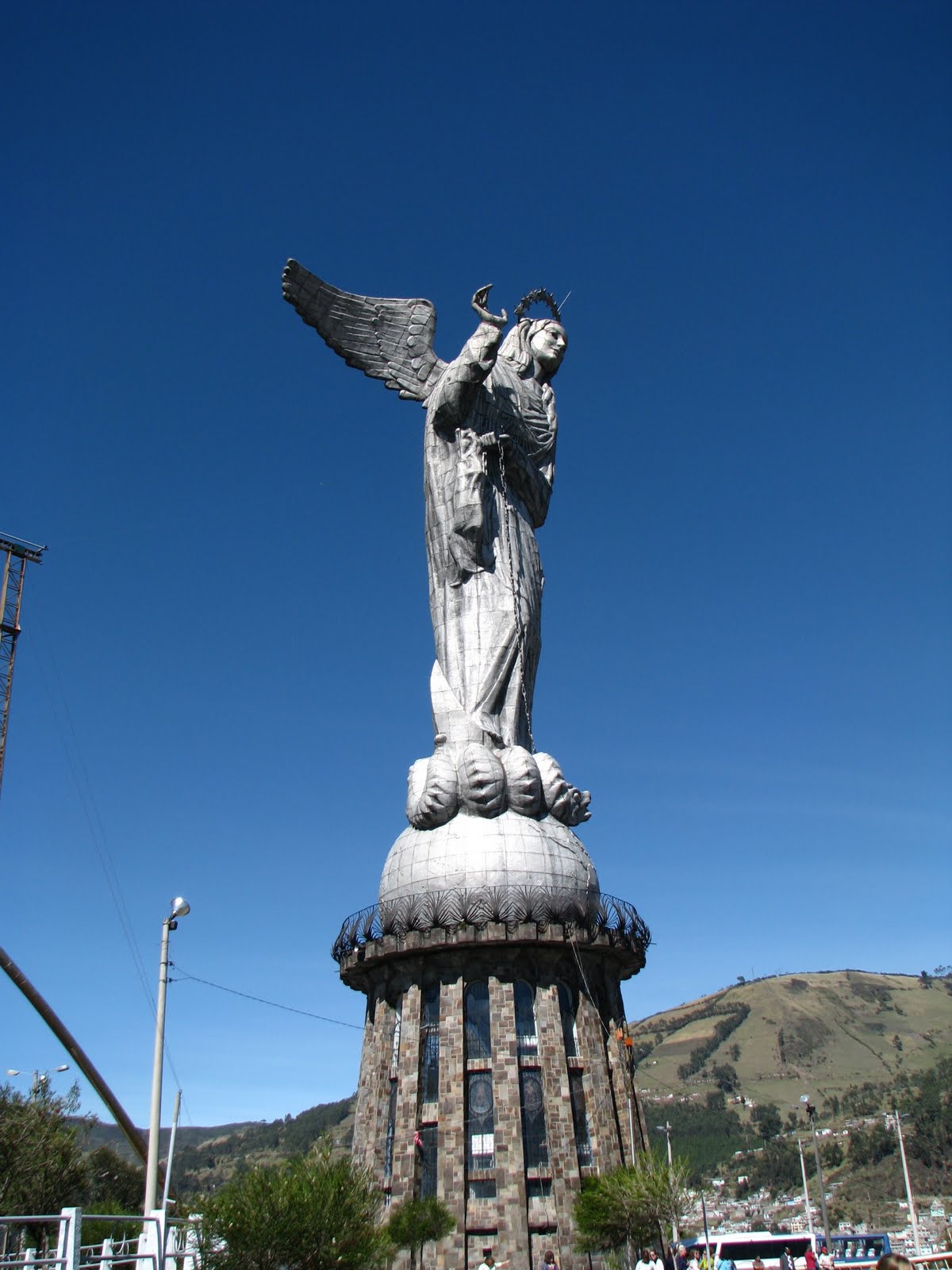
Mary, looking over Quito

A Mason all-seeing eye in a church


November 14, 2009
Location: Pasada del Maple, Quito
Weather: Sunny! Dry!

Yesterday was relateable to Dante's journey through Hell, just not as educational or as life-changing--just miserable.

Two hours down the Tiputini river, an hour of driving in a chiva, then another several hours on the Napo River. Playing with Spider monkeys in Coca was a nice diversion before our hellish airport ordeal.

One would think that in the Oriente, the most human, scalding part of the country, they would worship air conditioners. No, the airport is au naturale in the elements.

Not much else is worth noting except the incredible stench, fury, and impatience of our group. We all have ups and downs in our group dynamic and this is definitely a down!

Well, I lie. On the return trip on the Tiputini River, we spotted a pink river dolphin. Not much of it, mind you, mostly the lumped head and the cresting back. They are considered magical by the natives of Amazonia and also an aphrodisiac. They aren't very attractive creatures, other than their unusual pink color. Lumpy heads, misshapen bodies, but pale pink and completely unusual in the murky water of the tributary.

We flew into Quito at sunset. Cool, dry air never felt so heavenly. I love Quito. I have ever since I flew into it in 2007 and had my first taste of Ecuador. It's a lovely, lovely city.

Pasada del Maple is a lovely, twisting building, filled to the brim with bright colors and loads of character. It reminds me of the House of the Spirits because I haven't quite figured out the layout yet. It's got passages and hallways that go every which way.

The first thing I did after throwing my filthy clothes in a garbage bag (revolting--positively revolting--and as damp as if I'd just pulled them from the wash), was to jump into the hot, hot shower and dry myself completely for the first time in a week.

Having no clothes but a single pair of underware salvaged from my Amazonian wreckage, and a slightly sweat-stained bra until the boys returned with the extra clothes we'd left here in Quito, I was eager to get the wash done. But then... clean clothes! Perfume! Make up! Being CLEAN! It never did feel so wonderful. I can live with out it, but I prefer personal hygiene.

Dinner was free time to spend however we wanted to. Nine or ten of us found an Italian restaurant two blocks from the hostel. Seven full-sized pizzas later, at 10 PM, we returned to snuggle in our clean, dry beds.

After all this time, none of us have an qualms about lack of clothing around each other. We've all been so filthy and so awkward already, it's nothing. Someone accidentally walked in on me in the shower and the boys have no qualms about walking around in their boxers in our shared bathroom area. No one cares. Therefore, everyone sleeps in their underwear until our clothes are done by the hotel.

This morning, we toured Quito, overlooked the city from its guardian angel, Santa Maria. A church we visited was covered in 110 lbs. of leaf gold. It was magnificently revolting in its grandeur. The next church held hints of its Mason past. Although the Free Masons weren't permitted to meet at all, they used prayer to disguise their meetings. Triangles and all-seeing eyes decorate the Gothic edifice, despite Catholicism's push to eliminate the secret society. The city is so striking. The Spanish influence in the older blocks is absolutely beautiful. We didn't get to go up the Teleferico like I did last time I was here but we had a stunning day to explore the Presidential Palace and the surrounding areas.

Lunch was also free. Shannon, Jenny, Natalie, Kyle, and I went for sushi (my first time) and stocked up on supplies (namely gum and Nutella!).

This present moment finds me back at the Maple, journaling my way through Dr. Martin's final literature class on Wolves' Dream. Quito is dark at 6:30 (now) and my brain is quite finished with existentialism and the reality of truth. I'm a terrible English major. The cool thing about this "class" is that Abdon Ubidia, the author of the book is here discussing it with us. Unfortunately, it's in Spanish and I understand only a fraction of it.

November 30: Politics with Mama Isa

Abuelita

Mama Isa <3


November 30, 2009
Location: Cuenca
Time: 8:25 PM Weather: Cool because we are finally getting much-needed rain! Hopefully the hydroelectric plants will work full-time again.

My host mom and I ate dinner together and talked a lot about our day. She had a terrible day because her mother, who has Alzheimer's and is living with us for two weeks, kept her awake all night. Her hands hurt, her feet hurt, her head hurt. Poor Mama Isa only slept for a half-hour at a time. Abuelita was lucid for the last few days, but I guess she has been a wreck today.

When I returned from lunch to do homework, she was sitting in the kitchen crying. Two of my aunts, my uncle, and my mom were trying to calm her down, but she kept insisting that thieves had stolen her money. Mama said that she had dementia for quite a few years, but it's only been in the last three months that she has gone down hill. She thinks that perhaps it is the result of a long, difficult vacation to the United States. At any rate, Abuelita is only 80, blind, and declining mentally. I can only imagine what Mama Isa has gone through in the last six months with her husband (el hijo de puta), her mom's health in serious decline, and me, on top of it all.

I've decided to write my last American Literature paper on gender roles in The House of Spirits and compare those represented with my family's and my experiences here in Ecuador. I know that gender is such a cliché and unoriginal thing to write about, but both in the novel and in life here, it is undeniably evident that, even in a patriarchal society, the woman has a lot of power.

My mother and two of my aunts are incredibly strong, self-sufficient women. They take care of their ailing mother, their children, their other family, their household chores, they hold good jobs, and they're getting or have their masters degree, all at the same time. It amazes me frequently. They aren't sitting dejectedly on a corner with their hands out simply because their husbands aren't around, or depending on their brothers to provide for them, even though they could. They're making something out of their lives and succeeding in it, despite the machismo running rampant in the culture. After our conversation about Abuelita, we drifted on to politics.

I asked whether or not Mama Isa liked Correa.

“No! Nunca!” She replied emphatically. No, never.

She talked about how he was such close friends with Morales and Chavez, and how he is not doing anything good for the country. My cousin, Wellington (Willie), said that he liked Correa a lot because he gave free books to the schools. He defended him highly because of this. I asked my mom if it was true or not. It's true, she said, but the books the government provides are small, incomplete, and very few. They are inefficient and are resulting in students being unprepared, with a lesser capacity to learn than before. He is controlling what the schools teach by giving them free books. Also, she said that he is controlling the media. Nothing on television or in newspapers is unbiased.

Profesora Tossi said that on December 10, Correa would have a great power over the media. Worse, in my opinion, is the lack of government-funded libraries in the country. Mama said that a previous president opened many libraries with free internet and free rentals. Now, there are very few, and nothing is free. If you can't take it away completely, the next best thing is to make it impossible to afford and obtain. It's a very smart move on Correa's part if he's attempting to dumb down the people of Ecuador. Mama thinks he is following Chavez's and Morales' leads and is heading down the same path. Profesora Tossi thinks that he took away the monetary support, is forcing the libraries into bankruptcy, then will provide funding later on to make it appear as though it was all his doing to supply the people with them. His family comes from a low background, so he automatically has most of their support.

I know from my Orientation class that the Indigenous want nothing to do with him because of his pro-mining stance (especially after his platform against mining), but a lot of the poor and lower-class populations love him. Single women with children get a significant monetary benefit, but she, who works her fingers to the bone at school, gets 20% of her paycheck taken away for taxes. That would be Correa's socialist policies at work. I'm not sure if this is happening already or if he only wants it to happen right now, but Mama said that she and her husband own 60 hectares of land and, since they have no children, Correa wants to take away 40 hectares to give to the poor people. This is land that Mama Isa and her husband worked hard to pay for. Of course she doesn't want it taken away simply because the government deems it unnecessary for two people to own so much.

My teacher filled in the blanks for me about the land situation, today. Profesora Isabel Tossi said that Correa wants proof that every hectare of land is being farmed. If it isn't, he will take it away. “Capitalism isn't very good,” she told me, “but socialism is worse. It only helps the poor.”

We talked a little bit about the U.S.'s political situation and she told me that she thought Obama and Correa were similar: both from humble backgrounds, both a bit socialist, both aiming to increase taxes substantially for social aid, and both have enormous support from the lower classes because of their policies. I found that to be very interesting.

Not a country to support racial equality, I wasn't surprised to hear her add at the end, “Y el es negro!”

I laughed at this. It isn't an insult but a reflection of Ecuador's culture. Blacks are few and far between. Even though our cousin Leti is black and there is a large population in Esmeraldas, they aren't see as being very high on the cultural food chain because there just aren't many of them.

I'm amazed that Mama Isa and I could have this conversation. My limited Spanish slowed us down and I had to look up political words in my dictionary (mi companero) but I could understand it! It shows just how fare I've come in the last 8 weeks.

November 13: The Amazon, Where everything wants to kill you


A huge centipede
Braving the ant-infested heights of the observation towers
Paul swimming in the Tiputini


November 13, 2009

Location: on a boat on the Tiputini River

Time: 7:45 AM

Weather: Bright and sunny and hot—and humid, of course


I haven't felt the urge or the energy to keep up with journaling almost the entire time we've been here. The heat and the humidity drive me to search out my bed, which is somewhat cooler and perhaps a little drier than the rest of the jungle. Sluggishness just seems more natural in this heat than attempting anything more exerting than sleep. I've never felt anything like it, not even in the muggiest of Augusts or in the deep South. The discomfort of being in a sauna too long is constant here. The air here is tangible, wrapping itself around my neck and chest like a wet blanket. It's inescapable.

So are the critters here, unfortunately. A tarantula found its way into Katy, Caitlin, Emily, and Lizzy's cabin and had to be rehabilitated (by Natalie, the only one brave enough), as did the enormous gecko who also squatted in their room. That's the obvious downside of staying where the stuff of textbooks comes alive: you find them in the most inconvenient places like in the bathroom or on your pillow.

Wednesday, we climbed an observation tower taller than the trees, where we needed harnesses to cross the rickety bridges. Lovely. If ever there was an absolute need to overcome my fear of heights, it was then. Between every section of bridge, it was necessary to unhook my harness from one safety line to another. I'm proud of myself. No panic attacks, no wimping out, just sucking it up and doing it!

The ants were by far scarier than the height. They loved the trees we were in and were swarming over the surfaces like a sea of pepper with legs. I only managed to get bit a handful of times; however, I did find a colony of them squished in my boots later on. The bullet ants are the ones you really need to look out for. Only a few bites from them will send you into a raging fever.

The afternoon was spent hiking and taking a boat ride around a small lake known to house anacondas, caymans, and hideous, sqawking birds called guans. The water was dark, murky, and punctuated by spiny plants. To quote Dr. Martin, it was “lovely, but inhospitable."


They brought us by canoe to see the cayman and feed him meat. He wasn't very large but he tore viciously at the meat and I shudder to think that he is what is swimming beneath me in the river. We took a boat tour of the river and most of us swam in the river. I was entertaining the miserable Aunt and opted not to tempt the caymans or the piranhas. There was a bit of a hullabaloo when a hidden tree branch touched the legs of the swimmers and we had a good laugh at the "river monster." Maybe the scariest part of the river is the little fish that swim up your urethra and latch on, making urinating extremely painful. NO THANK YOU.

We did see glimpses of the shy, rare pink dolphin! They are secretive and very elusive. I never did get a good picture of them. They are fresh water dwellers and the subject of a lot of Amazonian myth.

From a website I (have later found) about them:

"Locals don't kill them because they think it's very bad luck. Don't eat them, because they think dolphins used to be humans long time ago and they can turn back into humans whenever they want. For some, the Boto turns into a handsome man at night, seduces and impregnates their wives and daughters before returning to the river and becoming Boto again. For others, they're considered evil or plain bad luck. When women give birth to a child with Spina Bifida - birth defect that prevents the baby's skull from growing properly, leaving an opening that resembles the blow hole of dolphins - locals say that their babies are the dolphins. To some Indian tribes, the gray dolphin is sacred, semi-divine creatures, Brujos (Spanish for Wizards) to be respected, almost reverenced." (http://www.unique-southamerica-travel-experience.com/amazon-pink-river-dolphin.html)

Thursday was our project day. Shannon, Lover of Lichens, led us up another observation tower to count, measure, and describe the conditions under which the lichens were growing. The work wasn't difficult: taking measurements, humidity, temperature, elevation, and numbers, but the bugs made things interesting. Lauren was our translator, I took measured, Jessica took notes, and Jenny and Shannon came up with cool names for the shades of colors our lichens grew in to identify them later: pea green, sea foam green, gray green, forest green, lime green, leafy green, etc., etc. We couldn't think of a better way to identify the species so we pulled from our Crayola color memories and found about 20 new colors!

By the way, we found out that 90% of the birds transported from the rainforest to North America die on the way, which makes the numbers in the 900,000s. Hideous. All of these magnificent birds who fly free here in the jungle are sent to live in cages. There's something so wrong with that.

The cabins had electricity for a few hours every day to allow our electronic devices to dry out. After those few hours, even the water was shut off for a certain amount of time. Pro: we could all drink the water at Tiputini and not worry about creepy bacterial content. Con: it was freezing. You don't want to waste water when it's that cold. You'd think that we'd be used to it by now with Cuenca's temperamental system, but we aren't. The water is still just as bone-chilling and my legs are just as covered in razor burn from trying to shave over goosebumps. At least it's a break from the heat!

It was interesting living in a cabin but hearing every word spoken by the surrounding ones. Regular conversations were interrupted by unseen people. I could hear Nate snoring every night.

Candlelit conversations are some of the most beautiful moments I will remember from this trip. Jessica, Shannon, Jenny, and I shared a cabin and played MASH and giggled until all ours of the night. When there are no cell phones or computers to distract you, talking and getting to know other people becomes much easier. Another lesson from this trip: I can live without hot water, electricity, and pizza and really fall in love with the simplicity.

Thursday night, our last night in the Amazon, we went on a night hike through the jungle with our guide, Santiago. Within the first ten minutes, I decided to be done with the jungle. Seeing two very poisonous banana spiders in 50 meters will do that. Our guide told us that if we were bitten by these spiders, the most poisonous in the entire world, we couldn't be evacuated from the jungle fast enough to save us. A cheery thought... A small(er) spider dropped out of the darkness onto Antonia's head and she shrieked, shaking out her curls desperately. After that, we pulled up our hoods to create a 4"x4" peephole.

So very many poisonous spiders here... Smothering humidity... Enclosing darkness... I nearly had a panic attack in the overwhelming, sweltering darkness. It was then when I began to count down the hours until a hot shower and a dry towel. Two girls found ticks on their stomachs and another group saw a coral snake. I am not a jungle girl like Jess. It's been fun but give me my mountains, my lakes, and my low humidity. Now.


Things that want to kill you:
-Snakes (very poisonous)
-Spiders (including the most poisonous in the world)
-Bullet Ants (who release pheromones calling other ants over, and if bitten more than a few times, will kill you)
-Centipedes (probably poisonous)
-Monkeys (if left to their own devices)
-Pumas
-The river creatures (caymans, piranhas, urethra fish, etc.)
-Native humans (probably)
-Humidity
-Plants
-Amazonian Molecules

We're now headed out in the same way we came in: canoe, chiva, boat, chiva, boat, bus. The only thing we're lacking is the check in point from the oil company, for which I am thankful. Everyone is ridiculously grumpy and sick of being squashed together with our luggage (some of which is unnecessarily large for this trip but I won't name names) and in need of getting the hell away from each other for just a little bit. Getting back to Cuenca will be a blessing.

November 10: Diversidad

Grenadilla
Two of the many magnificent butterflies in the Amazon.

One of the incredible orchids

Camp Tiputini


November 10, 2009

Location: Tiputini Research Center

Weather: Hideously HOT and Sauna-like


The day consisted of hiking through the jungle for a total of maybe eight hours today. Our group consisted of some wonderful people: Natalie (Science AND Spanish aficionado! What luck!), Brittany, Adam, Kyle, Dan (a temporary addition at the station) Antonia, Dr. Martin, and myself, all accompanied by Santiago, our very sweet guide.

One of our very first sightings this morning was a poison frog with a brilliantly red head. How Santiago spotted him is beyond me. It was not even the size of the pad of my thumb. He obviously has some talent.

Learning about secropia trees, bromeliads, strangler vines, and conga ants are one thing, but seeing them in person is totally different. They're real—not just the stuff of text books and foreign imaginings anymore.That's what I love about this trip: I am seeing what I've always learned about. Learning isn't theoretical, it's tangible and right in front of me. Isn't this how all education should really be?

Our first stop was an observation tower that rose higher than the tree tops at the top of a very long, very steep set of steps which wobbled every time someone took a particularly heavy step. I have no choice but to conquer my fear of heights if I want to do anything other than stand on the forest floor with the ants and the spiders. The top was, indeed, worthwhile. The ants were somewhat difficult to avoid, as well as the bees (one of which stung poor Antonia), but two scarlet macaws stood out like twin drops of blood in the tree tops, and butterflies simply surrounded the tower. I saw the lovely blue morpho, which made me realize just how beautiful six inches of blue brilliance can be, fluttering around in the dark selva. It's something I'll never forget--like this trip. It's permanently tattooed on my soul.

Other sightings: a walking palm (a real-life ENT! It moves about a meter a year to get to sunnier locations!), several small frogs, heard a howler monkey, and loads of very interesting mushrooms, flowers, and greeny, green greenery.

At the end of our morning hike, Santiago spotted a family of wooly monkeys in the tree tops. A little baby stared down curiously at us for quite a while, just waiting until we'd taken enough pictures. In Ohio, the only things crashing through the tree tops are B.W.'s wealth of squirrels. Hearing the monkeys is a lot different. I've no idea how they stay in the trees.

The same location provided an opportunity for us to see “lemon ants” in action. These tiny insects make their home in a tree and deposit an acidic chemical that kills the competing plants around the base of their home. It's an interesting symbiotic relationship. Santiago broke off a tiny twig and offered it to us to try. I scooped up a finger full following his example and popped them into my mouth. Lemon ants are called so because of their taste. Who figured that one out, I don't know, but I ate ants. I was extremely proud of Kyle. The boy never had ranch dressing in his life before I forced him to eat a slice of pizza with it as a dipping sauce, yet he tried ants without batting an eyelash. Very interesting.

Food at Tiputini has been very agreeable so far. Last night, on the way to the mess hall, I made a bet that dinner would be rice and beans. Sure enough: rice and beans. However, the beans slightly resembled chili and there was plenty of fruit to fill up on. Also, after hiking for hours, I simply don't—can't—care what I eat. I just have to stuff my face. Another lesson learned: it doesn't matter how picky you are, because after you've hiked for several miles, you don't care what you eat because it's food! We do really appreciate when they break out the peanut butter and Oreos. You've never seen a stampede like that before! PEANUT BUTTER? You'd think they had offered us a sip from the Fountain of Youth! My favorite fruit here in Ecuador has been the grenadilla, the odd globe that you crack between your fingers and slurp out the gummy seeds from within. It's a little like caviar in texture, I imagine, but sweet and refreshing.

The afternoon hike was filled with rain and creepy crawlies, like giant, five inch millepedes, spiders, snails, and walking sticks. The millepedes are pretty fascinating and look identical to a wet leaf frequently found on the jungle floor, coloring and all. I've had fun picking them up and showing them to people or picking up it's twin leaf and seeing if I can freak people out (I can haha).

We got a talk from Kelly, the man who is in charge of the Research Center, about what it's purpose is. It was built by Boston College, I believe, to provide an opportunity for research for students and faculty. It's main project, “Diversity and Abundances of Large Mammals and Birds in Undisturbed Rainforest of Amazonian Ecuador,” is photographing animals and birds in the jungle in attempts to see where and when they're active, and to find out more about their habits. National Geographic itself got involved by donating lots of night cameras and sensors for their research. Motion and heat detectors attached to the cameras snap photos of unsuspecting critters all through the day. The data received helps to show the abundance and diversity of species and indicates how healthy the jungle is.

The most oft-seen mammal is the red brocket deer, which appears in 40% of the photos. Nevertheless, pumas (the most far-ranging land mammal in the world, and also a Quechua word introduced to English), and other rare mammals have been captured as well. Rabbits, Amazonian red squirrels, and raccoons are a rarer sight. (Maybe we can give them some of B.W.'s?)

There are more species documented in this area than anywhere else in the world, especially bats and frogs. There are more species of frogs in one square acre than in the U.S. and Canada combined. That's mighty impressive.The crazy thing is they are still finding new species!

The showers here are freezing—blessedly. After all the hiking, I am so thankful to have icy streams cooling me off for the first time all day. Plus, it's good for my hair. My hair, consequently, has not fully dried since I got here. Soon, I'll look like a sloth with bits of moss in my hair.


Off to bed. Lights go out at 9:30 and we only have candlelight.