Search This Blog

Sunday, November 27, 2011

December 10: A Fairy Tale Plea to the Professors

Date: December 10, 2009

Weather: The same as it was fifteen minutes ago: I still want to be picnicking by the Tomebamba and enjoying the city

Once upon a time, there was a young American girl in a charming South American city. For months, she enjoyed wandering the cobblestone streets and buying the fresh bread that tickled her nose and made her want to bury herself in the piles of it in the panederias.

Her family in this charming little city was of the kindest, gentlest type. Her grandfather bought her ice cream on Sundays and her grandmother called the American her little baby and blessed her before she left every morning. Her mother brought her shoe shopping and peanut butter shopping and bought her delicious chocolate cakes every few days, and her uncle liked to tease her about her love of books and wine.

Every few weeks in the charming little village, the young American girl was whisked from her home, and taken a hundred miles away, where she inspected lichens and talked with crazy, burned-out hippies. She dearly loved this adventurous lifestyle, where she saw the most incredible things she'd every seen.

However, this fairytale has a dilemma, as every decent fairytale is expected to have. The young American girl was being forced by the wicked princes of the land she was visiting to write a book about her adventures by the last day of her journey. The young girl despaired for days. While she would have written about her adventures with the utmost willingness at another time, she was far more concerned with living the adventures at hand and resented deeply being locked away in a tower to finish the book. Her heart ached to be with her family, to eat more bread, to have more adventures. That wretched book prevented her from doing that.

She knew that the book would be wonderful, that it made sense to write it, that the princes would be extremely pleased if she finished it on time. Yet... the rivers and the cobblestone streets called to her. So she decided to do one thing—her only option. She decided to forgo the book and have her own adventures and enjoy life as it came to her.

The princes were dismayed and very upset. But then, in a wink and a flash, a benevolent shaman came to them with a magical potion which showed them the error of their ways until they begged the young American girl for forgiveness for hampering her education and her experiences in the charming land. She accepted their apologies, had wonderful adventures, and went back to her country fulfilled by experience and filled with bread.

And she lived happily ever after.

December 10: Exploring the city a few more times

Date: December 10, 2009

Weather: Sunny, lovely, the perfect weather for walking through the city and enjoying it

My mother loves her job. She's a math professor at a local college and loves it. I'm forever finding scribbled math equations on napkins and scraps of paper, not to mention the piles of notebooks filled with them.

The problem with her job is that, while trying to pay for the three-story house, she's forced to pay 20% in taxes. She feels secure in her job but hate that so much is being taken from her paycheck.

The school receives Correa's little “gifts,” the cheap books that don't prepare the students well enough for her class. Also, she just got her Master's degree on Friday and isn't receiving much of a benefit from it.

December 9: A heart-to-heart with Mama Isa

December 9, 2009

Location: Cuenca

Weather: Nice


It took me over a month to figure out where my host dad has been. One day, the day after Trevor and my 9 month anniversary, I came home from a telephone cabina sobbing my eyes out on Antonia's shoulder, who had the job of explaining to my mother why I was at my wit's end and unable to keep it together.

“Don't cry,” my mom told me. “Men aren't worth it. Don't cry.”

The next day, she asked me if I was better and pulled out a pile of photo albums to show me her past. She showed me her husband who has been gone for six months and who won't return her phone calls or talk to her in over two months. They were only married for six years and had several unsuccessful pregnancies. No wonder she seems like she's dying to become a mother. Her husband is off cavorting around the Oriente while she is stuck at home paying bills and worrying about making ends meet in their enormous house.

It's unfair to my mother to be stuck in the position of having to stay faithful and keep the house running simply because she has a womb. She told me that her husband is stupid and they can't get a divorce (thank you, Catholicism), but she can't do what she wants, either. Gender injustice strikes hardest in marriages, I think. It isn't the catcalls on the streets or the expectation that women are the ones who must cook, clean, and take care of everyone. It's in the marriages held together only by a piece of paper and the disapproving eye of the church.

My mom has to work, take care of her mother, watch her nephew every day, and be a proper woman. She has none of the freedom of a married woman but all of the responsibilities, despite Vincente's absence.

“What do I do with all of his clothes?” She asked, showing me the closets full of suits and shoes and hats.

“Burn it,” I told her.

She laughed and agreed that it was a brilliant idea. “Men are stupid. With the exceptions of Manuel.”

December 1: Foreign Familiarity

The views Antonia and I see on our walk to school every morning

December 1, 2009

Location: My room, Cuenca, 6:20 PM

Weather: Now, it's clouding over and getting dark because the sun will set within a half-hour, but today has been beautiful: sun, blue sky, 80s. It may be the first day of December, but I couldn't ask for a more perfect day.

I hate that we're leaving in a week and a half. Every time I walk through the city, I am reminded just how much I'm in love with it. Instead of going home for lunch, Natalie, Katy, Sara, Mark, Brittany, Kara, and I went to a vegetarian place near El Centro. After Carlos' wife's incredible meals, I've begun to like the idea of vegetarian meals. (It's far better than the dry, tough, sad excuse for steaks they serve here.) It was the only place in the city where I've seen pesto and real spaghetti, and it was absolutely stunning, for only $2.50, too.

Afterward, Kara, Britt, Natalie, and I wandered toward the San Francisco market in search of pirated DVDs and more gifts for our family. On the way back, I stopped and got Mama Isa a bright, cheery sunflower to cheer her up after such a hard week. It was $1, about twice as much as I paid for a bouquet a few weeks ago, but worth it. I walked back to school with Kara, swinging it as we walked.

A cart full of rosy mangoes and another of enormous, glowing strawberries were wheeled past us. We passed an old woman silently carrying a tray piled high with the whipped icing they're so fond of here, decorated with sprinkles and a few pieces of fruit, the sugar cones it's served in jutting from the creamy peaks. A man selling herbal medicines offered his services to us near the Old Cathedral, but we've already seen him around plenty of times. We know where to get a cleansing if we want it.

“If you could, would you live here?” Kara asked.

“Without a doubt,” I answered.

Of course the power shortages aren't convenient, and the current political situation leaves something to be desired, but I've fallen head over heels for this place, even more than I thought I would. I never imagined the hustle and bustle of the city could be so comforting or cheerful. The sounds of the car alarms and sirens barely register anymore because I hear them so much. Even the buses belching black clouds don't bother me any longer. I'm too busy looking at the old buildings, trying to peak through their open doors into the quiet sanctuaries of the courtyards inside of them, drooling over the scent of hot bread from the panaderias, listening to the chatter in Spanish, most of which I can understand now.

My walk to school in the cool mornings shows me the tiny children in their sharp uniforms being walked to school by their parents. Sometimes, the fathers carry their little girls on their shoulders, which makes Antonia and I shoot sidelong smiles at each other, remembering a time when it was us who were taking in a bird's eye's view of the world. On Calle Larga, always after we pass Calle Jerves and the dilapidated church covered with blue-striped tarps (the one that remind me of the Banana in Pajamas) so as not to have chunks of building fall on passersby, we cross paths with a tall officer. His branch of the military is unknown to me, but his blue shirt, navy jacket and pants, tilted black beret, and Rhett Butler mustache suggests that he's better than the police—or at least I believe he's better. He never speaks to us, but he must recognize the gringas he's passed every day for the last two months. He never makes kissing sounds (even when Antonia is wearing the dress that makes cars slow down and old men whistle), catcalls, or even gives a once-over. After I saw him stop to shake hands with a little girl yesterday, I've decided he's a class above the type of officer that stops, whistles, and harasses gringa girls from his police cruiser.

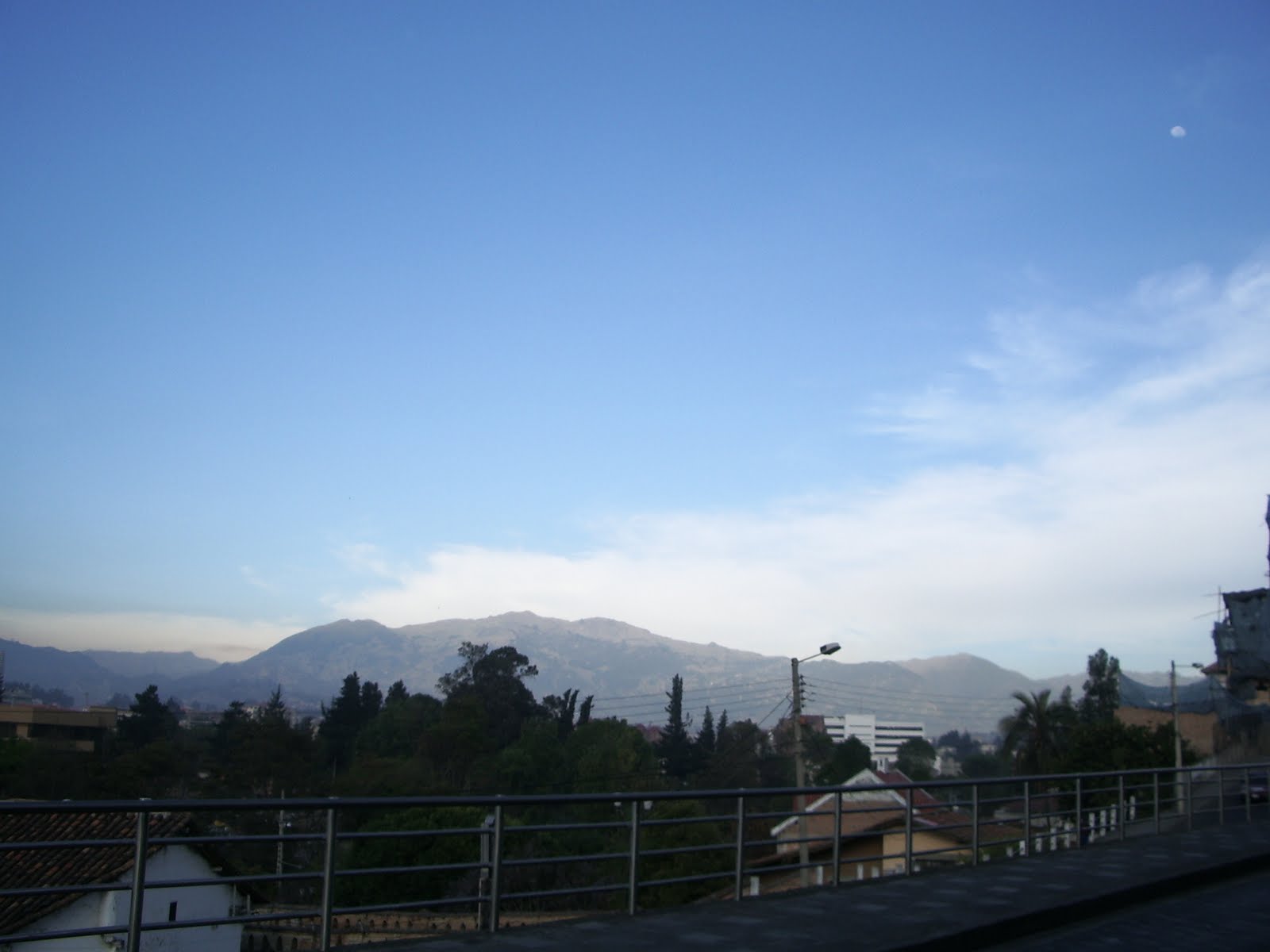
We pass a gap in the buildings around that block and see the mountains in all their glory. The morning mountains are misty and grey-green, not quite awake yet, but when we come home from school, they're blazing with the sun, green as can be. Evening is my favorite, when the entire range reflects the orange sunset and pink clouds have begun settling over them. An hour later, they're sparkling with lights and barely recognizable against the sky. Flat Ohio holds nothing on those mountains.

The familiarity in this city is perhaps my favorite part. The lady at the panaderia on Hermano Miguel and Sucre, one block away from school, knows that when Kyle, Adam, and I come in, we want hot bread. She points to the hottest before we even have to ask. The lady at the chocolate and fruit stand in the mall knows Jessica by name. The man selling Movistar minutes in his cabina at the top of the stairs on Calle Larga knows I'm studying Spanish here and knows I want $6 worth of cell phone minutes every time I come in. Adam gets the same cab driver into the city more often than not, and they strike up conversations together. Antonia and Ashley knows the people at the cell phone store where Marco still works. It's the same place Diego, Adam's host brother, brought me to after my phone was stolen, where I got a used phone for $30 instead of $50. I know Antonia has gotten the same deal from Marco, plus free repairs. Adrien at Zo lets us in either for free or for less than the cover charge because he likes dancing with Ashley, Lizzie, and I. It's quite often that we get free drinks out of the deal as well. We all know the scruffy little dog who has slept outside a clothing store since the first day. I can guarantee that I don't even frequent a place often enough to have the cashier recognize me, let alone cut me a break or know my name. The benefit of familiarity is more than a monetary one for me; it's feeling like this is really home, like I really belong here. I'm not just a gringa and a tourista.

A tiny, wrinkled Ecuadorian man asked me for directions today while I was waiting for Antonia at her gate. I gladly pointed him in the right direction of his house number and he thanked me and went on his way.

That's familiarity.

Saturday, November 26, 2011

December 6-8: Murphy's Law

December 6, 2009

Location: The road between Cuenca and Guayaquil, on the way to Montanita

Weather: Clear, hot, sunny, bound to get hotter as we near the coast


I hate this road. It's impossible to sleep on (as our 2AM trip to the Coast can attest) and it's nearly impossibly to write on. Hell, it's nearly impossible to remain at a 90 degree angle. The twists and turns and bumps and sudden stops and the truck currently hurtling toward us head on insure that I'm awake and at the very peak of anxiety. Fortunately, we'll be at the beach in three hours at the very most and there will be no stress whatsoever. Drs. Melampy and Martin, I know your papers are due on Friday. But... I'm going to remember the excitement of seeing one of Ecuador's most popular beaches more than sitting in my room all day typing, stressing, and studying. I think for the first time in my life, I am putting academics second. My GPA doesn't matter as much as the experience. I think that's been one of the most valuable lessons that this trip has taught me: to forget about a 4.0 and just enjoy being here. The things I'll regret most in twenty years are the things I didn't do—not the 4.0.

With five days left in Cuenca (and this hellish drive AGAIN at the end of that time), I am really getting nervous about leaving. My family is family here. They're more of my family than my those who never call and the thirty or so great-somethings I only see at family reunions. Mama Isa gets a kick out of being called “Mama” for the first time in her life—something I know she craves, just from the way she is magnetized to babies and children—and something her jerk of a husband never gave her the chance to become. Tio Manuel dotes on me and teases me and buys me my favorite white wine to go with our dinners and giant fabric hats shaped like mugs of Pilsener. Abuelito asks for me and buys me ice cream on Sundays. Abuelita suffering from Alzheimer's and blindness, is very endearing on her lucid days. “Erikita! Mi guagua!” She says, grinning from ear to ear when I kiss her good morning. Some days I sit on her bed and listen as she warns me of thieves and asks for the fifth time that day when I will be returning to Ecuador. Too soon, I always tell her. The other night, on one of her forgetful evenings, she asked to come dancing and drinking with me. She always blesses me before I leave the house. My maternal grandfather rarely says I love you when I say it to him and these people, with whom I've spent two and a half months, show and say loving things. I am going to miss them so incredibly much. I feel at home here, where I am white and speaking a different language, than I do in most places in the States.

As much as I love this country, I am not blind to its problems. The political issues are obvious, but my experience at the discotheque Velvet made me aware of just how corrupt it can be. Every country can be, everywhere has crime, every population has a percentage of people who should never have been born.

Velvet opened two months ago and is all the rage because of the novelty of a new club and the Plastics who go there. Word was that it was the place to go on Friday, so we went. We thought $6 was a bit steep, so when I struck up a conversation with a man outside who turned out to be the owner, I pushed up my chichis and told him how it was our last week in Ecuador and how we were only poor college students. He let us in for $5. He showed me a card with my name on it that was meant for Adam and I, on which was listed all the things we had to pay for: entrance fee, drinks, food, etc. At the end of the night, we were to pay before leaving. On the surface, the system looks a bit classier because there isn't a lot of cash floating around. It is, in truth, a way to make easy money. Lose the card? $250 fine. Rip it up? Hell to pay.

My feet were hurting and I wanted to get up early to do homework, so Adam and I went to pay. As I was adding up the bill at the counter, I couldn't believe what I saw. Three Coronas were true. One shot of Jose Cuervo was true. One pack of cigarettes was true. But three Cosmopolitans?

“No es verdad,” I told the worker in confusion, pointing at the marks on the paper. “Tuve solo uno.”

“No es mi problema,” he snapped.

I went down the list, explaining how it was all true except for the Cosmos. Talk to the bartenders, he told me. So I did. I found the bartender who had made me my single Cosmo and showed him the marks. “If I had three,” I told him, “I would be on the floor covered in vomit. You did not serve me three drinks.”

“No es mi problema,” he told me snootily.

Adam's drunken rage didn't help. He told the bartender we wouldn't be paying for something we didn't buy and ripped the card up into four pieces. That's when the bouncer showed up with the owner. I shoved Adam out of the way before a fight broke out and went to explain the situation.

“Who ripped up the card?” He demanded in English.

I told him it wasn't important, but he asked repeatedly. I explained the situation, I showed him the marks on the card, I told him as calmly as I could that three Cosmos would mean a passed out gringa on his club floor.

“Maybe your boyfriend drank them. It's not my problem,” he said, leading me to pay. Of course. Because my ex-marine friend really enjoys drinking sugary, pink, girly drinks. The owner didn't think that was so ridiculous. On the way there, I resigned myself to paying $15 in Cosmos instead of $5, and handed him two $10 bills. He handed them and the card to the cashier.

“Your bill comes to $40,” he told me, hand out. I gave him a twenty and went to leave when he stopped me. “$40—not $20.”

I stared at him. “I gave you $20 before in tens and I just gave you another $20. I paid you.”

“You're crazy. You never gave me any money before this. Did I hand him any money? No. See? You owe me $20 more. Just because you're American doesn't mean you can leave without paying. You come here and you don't respect me because I'm from Ecuador and you're from America.”

I think that's when my tears stopped and the hyperventilating started. The cops were going to be called. The owner thought Americans were crooked and rich and had no respect for the people and country I'd grown to love. I don't remember much besides seeing Lizzie in between the black spots in my vision and hearing her and Megan's mom, Diana, trying to calm me down over the roaring in my ears. After what seemed like an entire night, the owner, freaked out beyond belief, told me he'd forgive me the $20 and let Adam go.

“He has to go,” he said smoothly, “but you can stay if you want. I want you to stay.”

I stared at his fat, bald head blankly. This was the same man who had tried to dance with me and I had denied him because I had a boyfriend. It made a lot more sense, all of a sudden. I was still shaking and unable to breathe from the panic attack, but I managed to give him the most scathing look I've been known to posses and tell him that I would never want to stay and that I would spread the word about what happened to all the other gringoes club owners want so much to have in their clubs.

It wasn't until the next day that I found out that almost every single person in our group (20 people all together) had been overcharged, whether they were Ecuadoreans or gringoes. My cousin Leslie told us later that the club has already acquired the dubious honor of being known for screwing people over. A journalist we met at Amauta and later at Zo said he would write a scathing review of the club in the magazine he published for gringoes in Ecuador. Whether he will or not, I don't know, but I made no bones about spreading the word to everyone we met.

I told Adrian, the owner of Zo, about it last night and he said the same thing. It was not the first time he'd heard of something like that happening at Velvet. Adrien runs a good club. It may not be white and swanky and packed with Plastics, but he is honest and fair and gives me free drinks instead of charging me for extras. He pats my cheek and kisses it like I'm a naïve little girl but respects me, still treating me with as much fairness as he ever did.

“I'll miss you,” he told me when I hugged him goodbye. “Come back to my club the day you return to Ecuador.”

So guess who's getting a good online review at all the travel websites?


December 8, 2009
Loction: On the road back from Montanita
Weather: Crummy, cold, rainy

This is what we expected from Montanita:


This is what we got at Montanita:


Making the best of it with my lovely ladies:


Ashley was NOT pleased to have things with eyes in her soup

Antonia didn't mind

Pilsener <3
How many men does it take to change a tire? Four. Three to give advice and watch and one to actually change it.

Our happy bunch:


You know Murphy's Law? It says that everything that can and will go wrong at the worst possible time will indeed go wrong. That's what happened with the side trip that we planned for our last free weekend in Ecuador.

We had some extra money to spend on the trip so Dr. Martin, Dr. Melampy, Adam, Lauren, Sara, Ashley, Antonia, and I decided to go to the coast to spend a few days relaxing before the paper writing frenzy began. What could be better? The sun, the surf, relaxation, a few Pilseners, a nice tan to make everyone jealous when we return bronzed in the middle of December...

That SO didn't happen... None of it.

We should have turned around and gone back when our taxi busted a tire only a half hour outside Cuenca. We all got out to walk around in the sun while the three men looked on and offered suggestions to the taxi driver about the proper way to change a tire. How many men does it take to change a tire? Four, apparently. The girls just stood back and laughed.

I got some reading done for Martin's final paper on The House of the Spirits. It now looks like a very well-loved book. The pages have gotten damp and dog-eared, passages have been underlined and starred, and the spine is creased in multiple places. Generally, I take very good care of my books to the point of making them look like they've never been opened. But this book is incredible and looks like I've spent as much time with it as I have.

We got to the coast and it immediately began raining. It rains often in Ecuador, especially in the morning or early afternoon. Then it generally clears up and it's beautiful and sunny in the evening. No big deal, we thought, we'll wait until it passes.

It never did. Not Saturday, not Sunday. It poured.

The hostel was pretty cool looking, with a hot tub, a pool, and a big cabin overlooking the beach a couple miles away. The hostel owner was an ex-hippie who rambled on about his spiritual journey. "Knowledge is 'no ledge,' man!" He told us. He praised iowaska, or ayahuasca which means "spirit vine" in Quechua, one of the most powerful hallucinogenic drugs known to mankind. It's often used by shamans in rituals where some say that the visions will heal you from any "demons" you may have. He even had some on hand. No, thank you. That's what Zoloft is for.

[Later: Here's an interesting National Geographic article I found on it. Click on the blue, underlined letters to read it.]

The next day, Adam, Antonia, Ashley, and I decided to hike down to the beach and hope the sun cleared up the clouds. We slid down the muddy hillside, trying to avoid cow patties and getting our shoes soaked and muddied beyond all belief, and walked in the rain several miles until we got to the beach. We ate a crab and seafood chowder lunch with some massive bottles of Pilsener to make the day a little bit better. We were wet, freezing, and displeased that it was still raining and misting heavily. Sometimes life is just so ridiculous you have to laugh at yourself.

We made it into the town of Montanita, famous for its surfing community and its young, hippie crowd. Indeed, it lived up to its standards.

At that point, we were so worn out, we got a taxi back to the hostel and soaked in the hot tub for the rest of the evening. Then, we found an unexpected visitor: Sir Palmetto Bug and his merry band of roaches. Ashley dueled Sir Palmetto Bug but he skittered away to fight another day.

Gross. I don't think I've ever been so happy to leave a place.

Pros:
-ocean view room
-$15 out of pocket for the whole trip
-the beach
-the hot tub
-$2 crab lunch
-a small, intimate group
-finding the 200th bird for the Bio list

Cons:
-a hotel owner whose brain cells have obviously been burned away bit by bit (“Knowledge is having 'no ledge,' get it? Ha ha!”)
-rain
-muddy feet from sliding down the path to the beach
-battles with Sir Palmetto Bug and his Merry Band of Buggies who inhabited our rooms
-getting screwed over by a street artisan who tricked us (and by "us" I mean "Adam") into buying nothing

I think I'm ready to go home now.

Friday, November 25, 2011

November 25: This is not a damn train

On a stop in the mountains

Katy and Caitlin

This is a bus on tracks. Pooey.


November 25, 2009
Location: The damn "train"
Weather: Cool, cloudy and sunny

I am not pleased. Rarely am I disappointed on these trips but it's unanimous: we are not pleased. We're on a bus running on a train track. This is not the quaint, old-timey bus we were expecting. This is a bus running along the mostly-boring country side with a very loud, obnoxious guide shouting at us through her microphone and trying to get us to sing. I have slept for most of the trip.

We had been told that this train was one that people used to ride on top of to see the sides. "Used to" is the key verbiage, here. Apparently a couple dumb tourists sat too high when the train was going under a bridge and--whing!--were decapitated. Now, that's prohibited. Now, they've adapted the train to be a one-car bus on wheels.

I'd rather be climbing chimborazo at 20,000 feet.

Fortunately we've had a very pretty stop at a mountain pass that makes it look as if we're miles away from civilization (we are, I suppose...) but we've made the best of it!

November 24: It's the Climb- Chimborazo

Antonia and Ashley dancing to reggaeton :)

Huddling for warmth at the shelter below

Striking the Dr. Melampy pose--in Dr. Melampy's hat :)

Antonia

This is how we all felt

Como te llama? Or alpaca? not sure.


November 24, 2009
Location: Riobamba
Weather: Cold, cloudy

Just like every place is more and more amazing each new place, the hikes are getting progressively harder and longer, though also easier as I get into better shape. By far, by far today's hike was the hardest.

Mount Chimborazo is an extinct volcano that towers about all other peaks on earth. How? No, it's not the highest mountain above sea level in the world, but it is the closes peak to the sun. It reaches 20,565.0 ft! It's the tallest mountain in Ecuador. According to the ever-reliable source of Wikipedia (though this is a well-known fact), "its location along the equatorial bulge makes its summit the farthest point on the Earth's surface from its center" and therefore closest to the sun. Now, we didn't hike all that far. Emily, Paul, Lizzie, and Dr. Martin are going to tomorrow but it cost extra money and I have never been more exhausted physically in my life.

We began on a lower slope of the mountain, where we saw llamas, or alpacas, I don't know. It begins to look sparsely populated with vegetation at that level. The paramo is grassy with drought-resistant plants and very few animals.

It's cold--so cold we bundled into layers of pajama pants and field pants, sweaters, gloves, hats, and parkas. Snow was piled in places at higher levels.

We made it to about 16,000 feet above sea level. At that point, there is a little hut in which you can rest and stay the night if you want to brave the next 4,000 feet. There is relatively little elevation but it is very, very strenuous to walk. The air is so thin, you move only a few steps and feel your lungs burning for air. The normal breaths that you take don't seem to be enough, even though your body is telling you that it should be enough in normal situations. It's rewarding to say that you have made a pretty good hike at 16,000 feet (the highest I've ever been) but I'm beat.

At the top, I asked Dr. Melampy if I could borrow his hat for a photo op. He's always standing with one leg propped up on a rock, or on a step, like he's Captain Morgan. I have teased him about it but I was curious how he would take me blatantly imitating him today. I really, really like the guy. He has been so helpful and kind to me on this trip, even though I thought at first that he was a gruff fellow. As it turns out, he has a dry sense of humor and laughed at me when I struck his pose (see the photo above). I like him very much indeed. :)

The little cabins were perfect for hot tea and hot strawberry soup after we completed our hike. Some of our group even had to forgo the hike altogether because of altitude sickness. Again, I'm thankful that I am never afflicted with that. I'm terribly out of shape in general but my body has responded well to the changes I'm thrust upon it on this trip.

Tomorrow, we set off by train to Riobamba again. We've heard that there were some changes to the train so we shall see...